
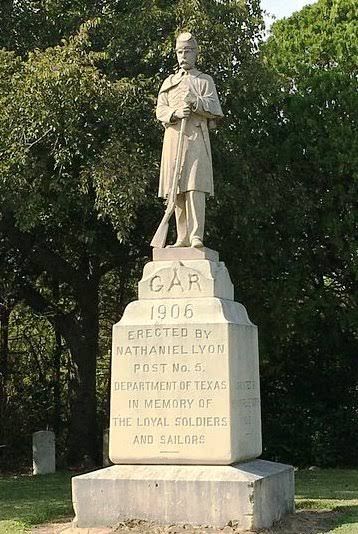
The Grand Army of the Republic (G.A.R.) was one of the most influential veterans’ organizations in American history. Founded in 1866 by Union veterans, it provided comradeship, assistance to veterans and their families, and a powerful voice for preserving the memory of the Union cause. In Texas, however, the G.A.R. faced a particularly distinctive environment: it was an organization of Union veterans operating in a state that had seceded from the Union and contributed thousands of men to the Confederate cause.
The Department of Texas, G.A.R. was formally organized on March 25, 1885, nearly two decades after the war. Local G.A.R. Posts subsequently appeared in many Texas communities, both large and small, bringing together former Union soldiers, sailors, and Marines. These men included both Texans who had remained loyal to the Union during the war, as well as Union veterans who had migrated to Texas after the war.
One of the most notable Texas posts was W. S. Hancock Post No. 2 in Galveston. A Galveston city directory notes the Post was organized in March 1886. As late as 1903, it still boasted 44 members. The members of the Post were not merely ceremonial veterans; they were active participants in their communities and in the broader work of the G.A.R.
The Department of Texas, G.A.R., also participated in annual statewide encampments, where veterans gathered to conduct business, elect officers, discuss veterans' affairs, and renew the fraternal bonds formed during the war years. Remarkably, many of the proceedings reports from those annual encampments still survive - extending from 1890 through 1932. They provide an important window into the lives and activities of the Union veterans in Texas.
One interesting fact is that the members of the G.A.R. in the Department of Texas represented only a tiny fraction of the state's Civil War veterans. Yet their sincere dedication to the principles of Fraternity, Charity, and Loyalty, enabled the organization to survive for decades. Their presence demonstrates that the Civil War story in Texas did not end with Appomattox. Union veterans continued to live, work, raise families, participate in civic life, and preserve their wartime memories long after the guns fell silent.
Today, the legacy of the G.A.R. in Texas survives through historical research and the various efforts of the Department of Texas and Louisiana, Sons of Union Veterans of the Civil War, the G.A.R.'s legal successor.
The Department of Texas, G.A.R. was formally organized on March 25, 1885, nearly two decades after the war. Local G.A.R. Posts subsequently appeared in many Texas communities, both large and small, bringing together former Union soldiers, sailors, and Marines. These men included both Texans who had remained loyal to the Union during the war, as well as Union veterans who had migrated to Texas after the war.
One of the most notable Texas posts was W. S. Hancock Post No. 2 in Galveston. A Galveston city directory notes the Post was organized in March 1886. As late as 1903, it still boasted 44 members. The members of the Post were not merely ceremonial veterans; they were active participants in their communities and in the broader work of the G.A.R.
The Department of Texas, G.A.R., also participated in annual statewide encampments, where veterans gathered to conduct business, elect officers, discuss veterans' affairs, and renew the fraternal bonds formed during the war years. Remarkably, many of the proceedings reports from those annual encampments still survive - extending from 1890 through 1932. They provide an important window into the lives and activities of the Union veterans in Texas.
One interesting fact is that the members of the G.A.R. in the Department of Texas represented only a tiny fraction of the state's Civil War veterans. Yet their sincere dedication to the principles of Fraternity, Charity, and Loyalty, enabled the organization to survive for decades. Their presence demonstrates that the Civil War story in Texas did not end with Appomattox. Union veterans continued to live, work, raise families, participate in civic life, and preserve their wartime memories long after the guns fell silent.
Today, the legacy of the G.A.R. in Texas survives through historical research and the various efforts of the Department of Texas and Louisiana, Sons of Union Veterans of the Civil War, the G.A.R.'s legal successor.