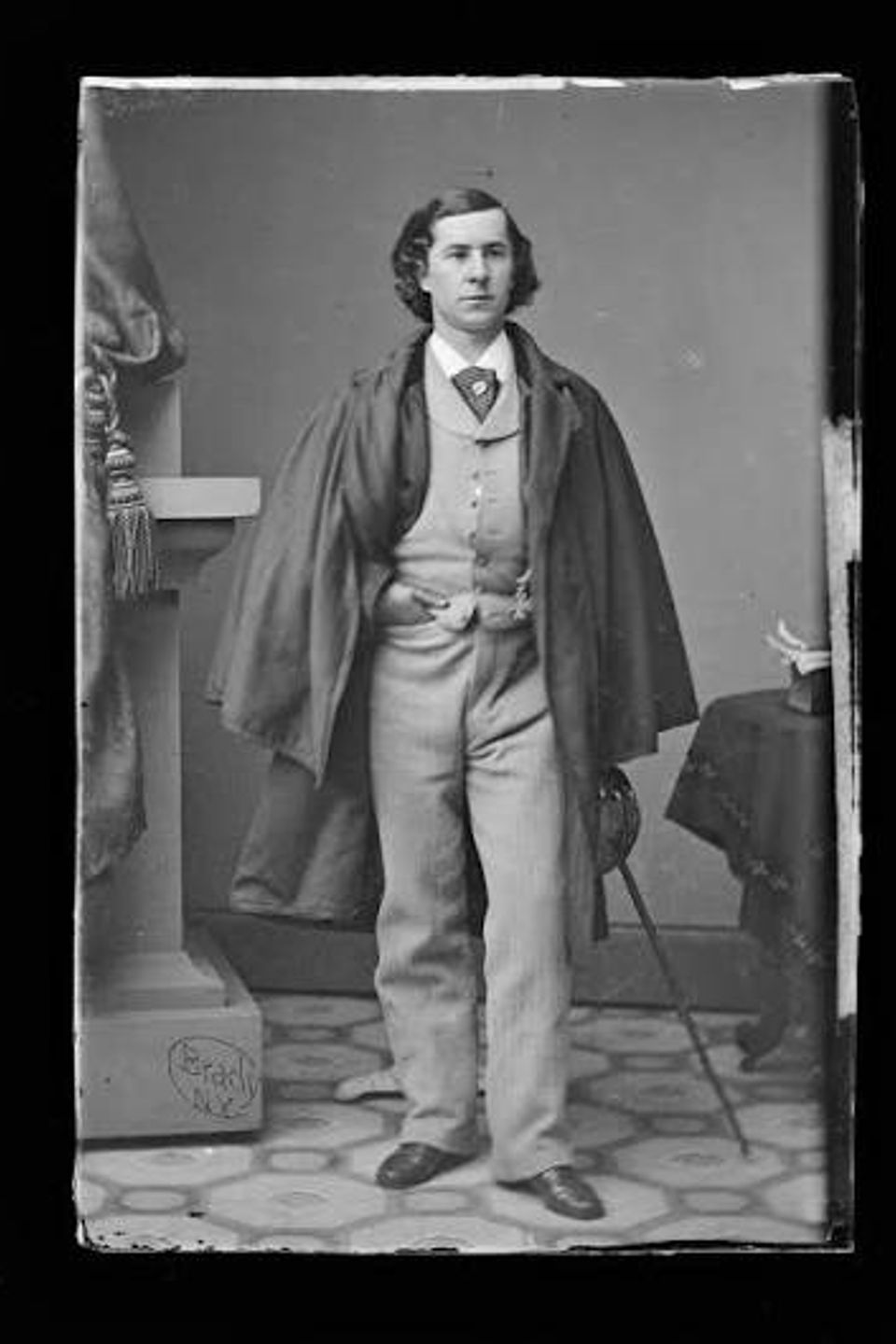
Elmer Ephraim Ellsworth is known as the first conspicuous casualty of the Civil War. He was born in Malta, New York, grew up in Mechanicville, New York, and lived in New York City. Eventually he moved to Chicago, where he worked as a law clerk. After studying military science in his spare time, Ellsworth became a colonel of Chicago's National Guard Cadets, introducing his men to the flamboyant Zouave uniforms worn by French colonial troops.
Ellsworth's unit eventually became a national champion drill team. In 1860, he went to Springfield, Illinois, and studied law in Abraham Lincoln's office, helping Lincoln with his campaign for president. When Lincoln was elected President, Ellsworth went to Washington, D.C. with him. President Lincoln nicknamed Ellsworth "the greatest little man I ever met." Ellsworth helped recruit soldiers after the secession crisis in 1861, raising a volunteer regiment from New York. He also traveled and set up a practice in Rockford, Illinois, where he was involved in the recruiting of several militia and cadet units.
It was during this time he met and became engaged to Carrie Spafford, the daughter of a local industrialist and city leader. They did not marry before he left for Washington, taking the New York regiment with him. Ellsworth died shortly after arriving in Washington.
On May 24, 1861, the day after Virginia seceded, Ellsworth led his men uncontested down the streets of Alexandria, Virginia, located across the Potomac River from Washington. He ordered some of his men to take the railroad station while he and a few other soldiers went to secure the telegraph office. While doing this, Ellsworth noticed a Confederate flag flying above the Marshall House Inn. He and four others quickly went up the stairs and cut down the flag down. Ellsworth was on the way down the stairs when the owner, James W. Jackson, killed him with a shotgun blast to the chest. Corporal Francis (Frank) Brownell of Troy, New York, immediately killed the innkeeper. Lincoln was deeply saddened by his friend's death and ordered an honor guard to bring the body to the White House, where it lay in state on May 25, 1861. Ellsworth was then taken to the City Hall in New York City, where thousands of Union supporters came to see the first man to fall for the Union cause. Ellsworth was then buried in his hometown of Mechanicville, New York, in Hudson View Cemetery.
Thousands of Union supporters rallied around Ellsworth's cause and enlisted in the Union Army. "Remember Ellsworth" was a patriotic slogan, and a New York regiment of volunteers (the 44th New York Volunteer Infantry Regiment) called itself the "Ellsworth Avengers" as well as "The People's Ellsworth Regiment."
Relics associated with Ellsworth's death became prized souvenirs. The Smithsonian and Bates College's Special Collections Library have pieces of the Confederate flag that Ellsworth had removed before he was shot. In 1894, Brownell's widow offered small pieces of the flag for sale for $10 and $15 each. The New York State Military Museum and Veterans Research Center in Saratoga Springs has most of the flag itself, along with Ellsworth's uniform, showing the hole from the fatal shot. Ellsworth, Wisconsin is named in his honor.