South Carolina Beginnings
James Alexander Garrett was born in Anderson County, South Carolina on February 23, 1847. His parents were Benjamin Franklin Garrett and Sarah Woods, both natives of South Carolina.
In October 1850. James and his family were living in Laurens County in northwest South Carolina. ‘Franklin’ Garrett was 30 and working as a farmer on real estate valued at $400. His wife, ‘Sally’, was also 30. Along with 3-year-old James, the household included his siblings Elizabeth (9), Raply (7), John (5), and Manning (8 months). The ages and birthplaces of the children place James among a growing family whose roots were firmly established in South Carolina.
However, the 1850 census contains a couple details that deserve attention. James’ sibling, ‘Raply’ is identified as female, although later records identify a brother named Ralph, also known as Rappley. The name similarity suggests a connection, and their ages align, but the records do not offer conclusive proof that they were the same person. The name Manning also appears later as Maning, again illustrating the fact that spelling variations and other errors often occur in the historical records.
A Move to North Georgia
Between 1850 and 1860, the Garrett family left South Carolina and settled in northwestern Georgia. On July 20, 1860, they were living in the small rural community of Pond Springs in Walker County - near the Tennessee state line, approximately 15 miles south of Chattanooga.
James’ father was 43 and farming on real estate valued at $360. He also owned personal property worth $150. His mother, Sarah W. Garrett, was 33 and keeping house. His siblings included Ralh [sic] (18); John (16), James (10), Maning (9), Elizabeth (7), Nathan (5), Washington (4), and Sarah J. (1). The four older children had been born in South Carolina, and the four younger children were born after the family had migrated westward to resettle in Georgia.
The family’s new home was in a region that would become one of the important military corridors of the Civil War. Chattanooga was a vital transportation center, connecting railroads and roads leading into Georgia and Alabama. Its location made control of the city important to both armies. The Union Army advanced toward Chattanooga in 1863.
Military activity in northwestern Georgia became especially intense in September that year. Union and Confederate forces maneuvered through Walker county and the surrounding countryside leading up to the September 18-20 Battle of Chickamauga. Other lesser skirmishes also occurred in Walker County, including: McLemore Cove; Lee and Gordon’s Mill; Dry Valley; Glass’s Mill; and the area around Rock Spring. These were not distant campaigns taking place in another part of the country; they occurred in the same county where the Garrett family had made its home.
Following the Confederate victory at Chickamauga, the Union troops fell back to the north about 15 miles to Chattanooga, where they then faced a siege. However, the situation soon changed. About two months later, Union forces broke through the Confederate lines, culminating in the Battle of Missionary Ridge on November 25. The battered Confederate army withdrew into Georgia, leaving Chattanooga, Tennessee firmly in Union hands.
For the families living in Walker County, Georgia, these events meant that military forces were operating close to their homes. The activities of campaigning armies inevitably devastated the local landscape, and their heavy demand for food and supplies took a severe toll on residents. The Garrett family’s precise experiences during this time are not known, but their home in Walker County placed them within the area of these operations.
Union Army Volunteer
By the spring of 1864, James Garrett had reached age 17. On March 31, he volunteered for service with the Union Army at Chattanooga. His enlistment document identifies him as a farmer born in Anderson County, South Carolina. He pledged his allegiance to the United States and agreed to serve for three years.
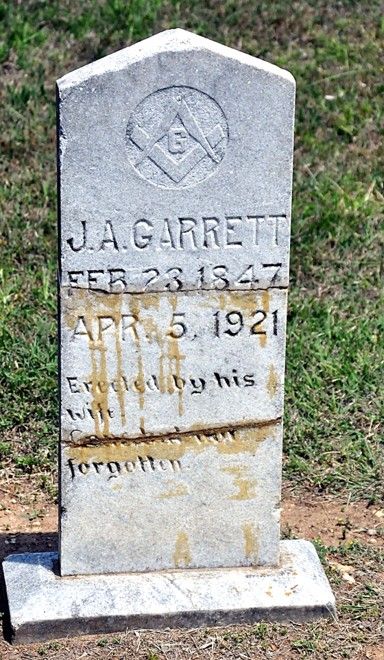
James claimed he was 18, which conflicts the February 23, 1847 birth date recorded on both his gravestone and death certificate. His true age was 17 years and 1 month when he enlisted. In addition, the later 1900 federal census notes his birth occurred in February 1848, making him younger still. Even though the 1847 birth date is supported by his death certificate and by his gravestone inscription, the age discrepancy on the enlistment record should be preserved.
The location of James’ enlistment is also noteworthy. Chattanooga was a relatively short distance from the 1860 Garrett homestead at Pond Springs, Georgia. The journey to Chattanooga would have been manageable, although the precise route he took and his residence immediately before enlistment are not firmly established.
James was assigned to Company K of the 12th Tennessee Cavalry, a Union regiment. This distinction is important because a separate Confederate regiment also carried the designation 12th Tennessee Cavalry. His enlistment and pension records clearly identify his service with the Union Army.
The 12th Tennessee Cavalry had begun organizing at Nashville, Tennessee in August 1863. Company K was mustered into service on April 11, 1864, just 11 days after James volunteered. His enlistment also came during a period of renewed military activity in northwestern Georgia.
The regiment’s early duties included guarding the Nashville and Northwestern Railroad and conducting scouting operations in Tennessee and northern Alabama. Its service record also lists operations in Middle Tennessee and the Nashville Campaign.
In early May 1864, Union forces began the Atlanta Campaign, moving south and east from the Chattanooga area. The opening operations included fighting around Tunnel Hill, Rocky Face Ridge, and Dug Gap, followed by the movement through Snake Creek Gap toward Resaca. These operations brought military activity back into the region not far from Walker County. James’ service placed him among the Union cavalrymen whose work helped protect transportation routes and maintain Federal control in Tennessee.
Marriage, Family, and Farming
James survived the war, apparently unscathed, and transitioned into domestic family life. He pursued farming, married, and became the father of at least six children, including: Stella (born in 1874), Millard (1880), Alice (1884), Daisie (1885), William Randolph (1888), and Mollie (1891). The identity of James’s first wife - the mother of these children - has not been established.
James has not been found in the federal census records for 1870 or 1880. This is unfortunate because those records would offer insight into his growing family, his movements, and his occupational endeavors. Since his daughter Stella Garrett was born in Texas in May 1874, and his son Benjamin Franklin Garrett was also born in Texas around 1877, it appears that he spent a few years in the Lone Star state trying to get his young family established.
But it wasn’t long before James moved his family back to Walker County, Georgia. His next son, Millard Garrett, was born there in November 1880. The reason for the return to Georgia is not known, but his first wife had apparently accompanied him. His next three children were also born in Walker County - between April 1884 and January 1891
On January 17, 1890, James filed for a military pension from Georgia based on his wartime service with Co. K, 12th Tennessee Cavalry. His claim was approved, resulting in Pension Certificate #999078.
James’ first wife seems to have passed away sometime between January 1891 and 1896. A record of her death has not been located as yet. With a handful of young children to raise, James did not remain unmarried for long.
He wed his second wife, Josephine Littlejohn, in the mid-1890s. Their exact marriage date remains uncertain. The 1900 federal census shows they had been married for three years, suggesting their marriage occurred about 1897. Other online sources suggest they were married in 1896, while the 1910 federal census shows 15 years of marriage, which points to approximately 1895.
Josephine was born in Georgia, but her exact date of birth is also uncertain. While her online Find A Grave memorial gives her birth year as 1862, her reported age on both the 1900 and 1910 census records infer 1864. These differences are minor, but worth noting.
On June 19, 1900, James and Josephine were living in the town of Smithfield in north-central Tarrant County, Texas. He was a 52-year-old farmer and was renting his farm. The household included several children, including: Benjamin F. (23), Daisie (14), Randolph (12), and Mollie (10).
The 1900 census also notes that Josephine was the mother of one child who was still living. Since all the children present in the Garrett household were born before 1892, she apparently had given birth sometime before her 1895-1897 marriage to James. The absence of her child on the 1900 farm suggests he/she had already reached adulthood and lived elsewhere.
On April 6, 1907, James filed for an increase in his military pension stipend. The results of his claim are not known at this time, but the changing pension laws likely worked in his favor.
The James Garrett family was still living in Smithfield, Texas in April 1910. He was 63 years old and farming on his own account. Unlike the rented farm reported in 1900, the 1910 census indicates that he owned his farm free and clear. Josephine was 46. James’ 89-year-old mother, Sarah Garrett, was now living in the household. The elderly lady was a widow and the mother of 11 children; 6 of whom were still living. Eugene Littlejohn, age 33 and unmarried, was also lodging with the Garretts, identified as James’s brother-in-law.
A Comrade of the Grand Army of the Republic
In September 1884, a local G.A.R. Post was organized in Fort Worth. It was named Fort Worth Post #4, and was an element of the Department of the Gulf, G.A.R. The first Post commander was Capt. William S. Parmley, a Union veteran of the 33rd Iowa Infantry.
Following Parmley’s premature death in March 1885, Fort Worth Post #4 was renamed in his honor. The new Department of Texas was also permanently organized that month. Parmley Post #4 proved to be a vibrant and flourishing Post within the Department of Texas for many years, bringing Union veterans together for comradeship, mutual assistance, and the preservation of the Union veterans’ legacy.
James is included on the April 1910 membership roster of the Department of Texas. It identifies him as a member of Capt. William S. Parmley Post #4 of Fort Worth and gives his residence as Tarrant County. This membership connected him with other former Union soldiers living in the Fort Worth area, providing an opportunity to renew old associations, remember their service, and maintain a public presence in their communities.
A Return to Chattanooga
Under the headline “Local Grand Army Men Arrange for the Chattanooga Reunion,” the Fort Worth Record-Telegram newspaper reported on a meeting held at the courthouse by the Parmley Post in August 1913. The G.A.R. veterans met to plan for attending the upcoming 47th Annual National Encampment of the G.A.R. in Chattanooga, Tennessee.
James A. Garrett of Smithfield was among those who planned to make the trip. A special Pullman car was being arranged for their transportation, leaving Dallas on September 13, 1913. The encampment was scheduled to begin in Chattanooga on September 15.
It had been nearly 50 years since the Civil War campaigns made Chattanooga the "Gateway to the Deep South." The 1913 National Encampment of the G.A.R drew Union veterans from across the country back to the site of their pivotal victory.
For James, the trip was even more personal. It meant a return to the city where he had volunteered with the Union Army in March 1864 – an interesting link between his wartime experience and his later life as a member of the Grand Army of the Republic.
Final Years
In January 1920, James and Josephine were still living in Tarrant County, Texas. He was 73, and continued to work as a general farmer. He owned his property on Smithfield Road free and clear. After decades of changes in residence and family circumstances, he had firmly established a lasting home in the Smithfield community.