Skip to content
.


James Garbutt


Early Life and Military Service

James Garbutt was born in England about 1821. Little is known about his childhood, parents, or the circumstances that eventually brought him to the United States. A census record identifies England as his birthplace, as well as the birthplace of both his parents. By the time the Civil War began, he was living in Ohio and was approximately 40 years old.

Garbutt enlisted in the Union Army as a Private on September 4, 1861. He mustered into Co. G, 5th Ohio Cavalry, a regiment organized during the early months of the war. He was older than most of the men who volunteered for military service, but he nevertheless committed himself to a 3-year enlistment.

The 5th Ohio Cavalry was organized at Camp Dick Corwin in Dayton, Ohio, and entered federal service in the fall of 1861. Its companies were recruited from different parts of Ohio, and the regiment spent much of the war engaged in operations across the western theater. They performed a variety of duties, including scouting, reconnaissance, escorting military columns, protecting supply lines, and occasionally participating in combat against Confederate forces. Garbutt served approximately 3 years and 2 months.

An inconsistency appears on the Special Veterans Schedule of the 1890 Census. While the Schedule correctly identifies his service as a Private with the 5th Ohio Cavalry, it shows his unit as Co. ‘C’, rather than Co. ‘G’. This designation conflicts with his pension records, which identify his service with both Co. G and Co. L. The Co. ‘C’ entry therefore may represent a recording error on the census sheet.

Whatever the explanation for the discrepancy, the principal facts of Garbutt's military career are clear: he entered Federal service on September 4, 1861, served as a Private in the 5th Ohio Cavalry, and was mustered out on November 29, 1864. His 1890 Special Veterans Schedule entry also indicates that he reported no disabilities resulting from his military service.


A New Career in Illinois

Following his military service, Garbutt established himself in Illinois, where he appears to have pursued a career in the hotel and hospitality business. The newspaper accounts that survive from the 1870s reveal a man who was active in local business affairs and who moved among several communities in central and east-central Illinois.

One of the earliest references comes from the Paxton Weekly Record of May 15, 1873. The newspaper reported that James Garbutt, described as an enterprising townsman and owner of the Garbutt Hotel, was preparing to transfer all his right, title, and interest in his hotel property to A. S. Guthrie. The transaction was valued at $10,000, a substantial sum for the period (about $281,260 in 2026 dollars).

This newspaper notice suggests that Garbutt had become an established businessman in Paxton, the county seat of Ford County, Illinois. His ownership of a hotel and the newspaper's favorable description indicate that he had developed a reputation in the community.

A few months later, another newspaper item placed Garbutt in Gibson, also in Ford County. The October 10, 1873, edition of the Bloomington Pantagraph reported that the Springfield Journal had described his appearance before U.S. Commissioner Adams on September 18. Garbutt was charged with selling liquor at retail without paying the required federal taxes, and for failing to display the appropriate revenue stamps at his place of business. He also faced a charge involving the sale of liquor at wholesale in violation of federal revenue laws.

Garbutt furnished bonds of $500 on each charge and was released pending his appearance before the U.S. District Court. The newspaper account notes the charges and his release, but does not provide the outcome of the court proceedings, if any. It would be inappropriate to assume that he was convicted.

The precise nature of Garbutt's business in Gibson is not established by this report, although the liquor-related charges suggest that he was involved in an establishment where alcoholic beverages were sold. Whether this was connected to his hotel interests or represented a separate business venture remains uncertain.

By September 1874, Garbutt was associated with another hotel, this time identified as the Virginia House. A complimentary notice published in the State Journal-Register of Springfield, Illinois, praised him for his hospitality during a fair. The writer expressed particular appreciation for the attention and favors received at the establishment, describing the rooms as pleasant, the beds as clean and inviting, and the dining menus as excellent.

The newspaper went on to call the Virginia House one of the best establishments of its class in the country and noted that it was becoming a favorite stopping place for travelers. Garbutt was described as courteous and obliging. This favorable account provides a rather different impression from the earlier report about federal revenue violations. It portrays Garbutt as a capable hotel proprietor who understood the importance of providing comfortable accommodations and attentive service to his guests.

His business fortunes, however, may not have remained consistently favorable. In April 1876, the Paxton Record published the notice of an upcoming Sheriff's sale. The sale was connected to a judgment obtained against James Garbutt by John C. Patton. It commanded the Sheriff of Ford County to sell Garbutt's substantial tract of land to satisfy the judgment. The land consisted of the north half of Section 21 and the south half of the southeast quarter of the same section, in Township 23 North, Range 7 East. The property was scheduled for sale by public auction at 2 p.m. at the courthouse in Paxton on May 12, 1876.

This unfortunate event suggests that Garbutt was experiencing at least some financial or legal difficulties during this period. The notice does not establish the original circumstances of the judgment or the ultimate disposition of the property, but it does provide another glimpse into the changing fortunes of his business and property interests.


Arrival in Fort Worth


By early 1877, Garbutt had left Illinois and made his way to Fort Worth, Texas. His arrival coincided with a period when the young city was beginning to develop its reputation as a commercial center for North Texas.

The Daily Fort Worth Standard announced on February 18, 1877, that the management, control, and proprietorship of the Pacific Hotel in Fort Worth had been transferred to James Garbutt. The previous proprietor, Mr. Coleman, had relinquished his responsibilities and connection with the establishment.

The newspaper introduced Garbutt favorably, noting that gentlemen in Fort Worth who had known him at his former home in Jacksonville, Illinois, regarded him as an experienced hotelman and a clever, genial gentleman. This reference is particularly useful because it identifies Jacksonville as Garbutt's previous home. Although the earlier newspaper accounts place him in Paxton and Gibson, Illinois, the Fort Worth notice provides a direct connection to Jacksonville. It is possible that he had lived or conducted business there between his other Illinois ventures, although the available information does not establish the exact sequence.

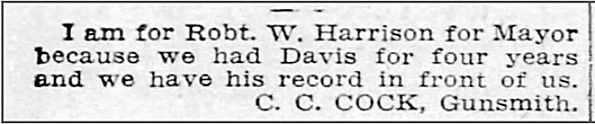
 
1916 news item   political endorsement
Charles also maintained an interest in local civic affairs. In November 1916, the Fort Worth Star-Telegram published a tongue-in-cheek political endorsement from him supporting Robert W. Harrison for mayor. Unfortunately for Charles's preferred candidate, Harrison lost to incumbent William Davis. The humorous endorsement provides a glimpse of a man who, despite his advancing years, continued to take an interest in local affairs.

Final Years and Lasting Legacy

By January 1920, Charles C. “Cox” was 75 years old and still living on East Belknap Street in Fort Worth. The federal census identified him as a widower and laborer. His 45-year-old divorced daughter, Mollie “Cox,” was living with him, along with a 24-year-old divorced roomer named Ethel Schellinger. Although his occupation was now listed as laborer rather than gunsmith or locksmith, Charles apparently remained active in some form of employment.

His G.A.R. involvement also continued. At the 1923 Annual Encampment of the Department of Texas, held in Houston, Charles C. "Cox" was identified as Officer-of-the-Day for Parmley Post No. 4. Even in his late seventies, he remained sufficiently active in the organization to accept responsibilities among his fellow veterans.

Time, however, was beginning to take its toll. Charles had survived the dangers of the Civil War, including repeated captures and imprisonment, and had successfully established a new life after moving through several states. By 1927, he was approaching his 83rd birthday, but he would not live to celebrate it.
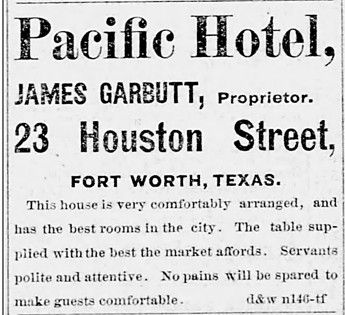
1877 newspaper item   garbutt at the pacific hotel
Garbutt wasted little time introducing himself to Fort Worth. An advertisement appeared in the March 14, 1877, edition of the Daily Fort Worth Standard announcing:
 
Pacific Hotel
JAMES GARBUTT, Proprietor.
23 Houston Street,
FORT WORTH, TEXAS.

The advertisement described the Pacific Hotel as comfortably arranged, with some of the best rooms in the city. It promised guests a table supplied with the best the market could provide, along with polite and attentive servants. The proprietor assured prospective customers that no effort would be spared to make them comfortable.

The advertisement suggests that Garbutt intended to build upon his previous experience in the hotel business and establish himself in his new community. His reputation as an experienced hotelkeeper, already recognized by acquaintances in Fort Worth, undoubtedly helped him make the transition.

His association with the Pacific Hotel, however, does not appear to have been his only business interest in the city. The Fort Worth city directory for 1878–79 lists James Garbutt as the resident managing proprietor of the St. Louis Wagon Yard, located at the northeast corner of Sixth and Jones streets. A wagon yard was an important commercial establishment in a developing frontier city. Such facilities provided places for travelers and merchants to leave their wagons, teams, and equipment while conducting business in town. Whether he continued to operate the Pacific Hotel while managing the wagon yard is not clear, but the two references suggest that he was establishing a broader business presence.


Family Life in Texas

The 1880 federal census provides our first clear picture of Garbutt's household in Texas. Enumerated on October 5, 1880, in Precinct No. 1 of Tarrant County, he was living with his wife, Sophia. James was recorded as 60 years old and employed in farming. He was born in England, as were both of his parents. Sophia, age 42, was identified as his wife and was born in Sweden to Swedish-born parents. She was keeping house.

The census provides an interesting contrast with the earlier newspaper accounts. Only a few years before, Garbutt had been operating hotels and managing a wagon yard. By 1880, he was identified as a farmer. Whether this represented a permanent change in occupation or simply another business interest is unknown.

The couple's age difference was approximately 18 years, and Sophia's Swedish background added another dimension to the family's story. Unfortunately, the available information provides no details about their marriage, or whether or not they had any children. The census record only establishes that they were living together as husband and wife in Tarrant County, Texas in 1880.

Garbutt's continued presence in the Fort Worth area is confirmed by subsequent records. His name became associated with the growing community of Union veterans who had settled in Texas following the Civil War.


A Union Veteran in Fort Worth

On June 29, 1887, James Garbutt filed an application for a military pension based on his Civil War service. The application was filed from Texas and resulted in Pension Certificate No. 406079. His pension file index card verifies his service with Co. G of the 5th Ohio Cavalry.

As mentioned above, the Special Veterans Schedule of the 1890 federal census also provides details of Garbutt’s military background. In June, he identified himself as a former Private of the 5th Ohio Cavalry with an enlistment date of September 4, 1861, and a discharge date in November 1864 - after having served 3 years and 2 months.

Garbutt’s postwar life also included the familiar challenges of maintaining property and supporting himself. An advertisement in the June 28, 1890, edition of the Fort Worth Daily Gazette offered a 6-room house and 30 acres of pasture land for rent. The property included a good artesian well and all necessary outbuildings, and was located approximately 2½ miles north of the courthouse. Interested parties were instructed to “Apply to James Garbutt, on premises.”

This advertisement suggests that Garbutt had substantial property interests in the Fort Worth vicinity. The inclusion of pastureland, a well, and outbuildings is consistent with the farming occupation noted on the 1880 census. It also demonstrates that he was involved in renting property, perhaps as another source of income.

By this time, the Grand Army of the Republic (G.A.R.) was firmly established in Texas. The Department of Texas was permanently reorganized in 1885 by Union veterans living in the state. It provided a fraternal organization through which the former soldiers could honor their fallen comrades, and support the interests of Union veterans.

Parmley Post No. 4 in Fort Worth was among the earliest local posts chartered within the Department of Texas. Garbutt became affiliated with this Post. His membership is confirmed in the report of the Proceedings of the 10th Annual Encampment of the Department of Texas, G.A.R., which had been held in Waco on April 22-24, 1895. The proceedings report included a Death Roll listing the names of 29 veterans of the Department who had died since the preceding encampment. James Garbutt of Parmley Post No. 4 was among those named.

This is an especially useful record because it confirms his G.A.R. membership and places him within the organized community of Union veterans who had made Texas their postwar home. His membership in the G.A.R. offered an opportunity to reconnect with men who shared his wartime experiences and his allegiance to the Union.

 
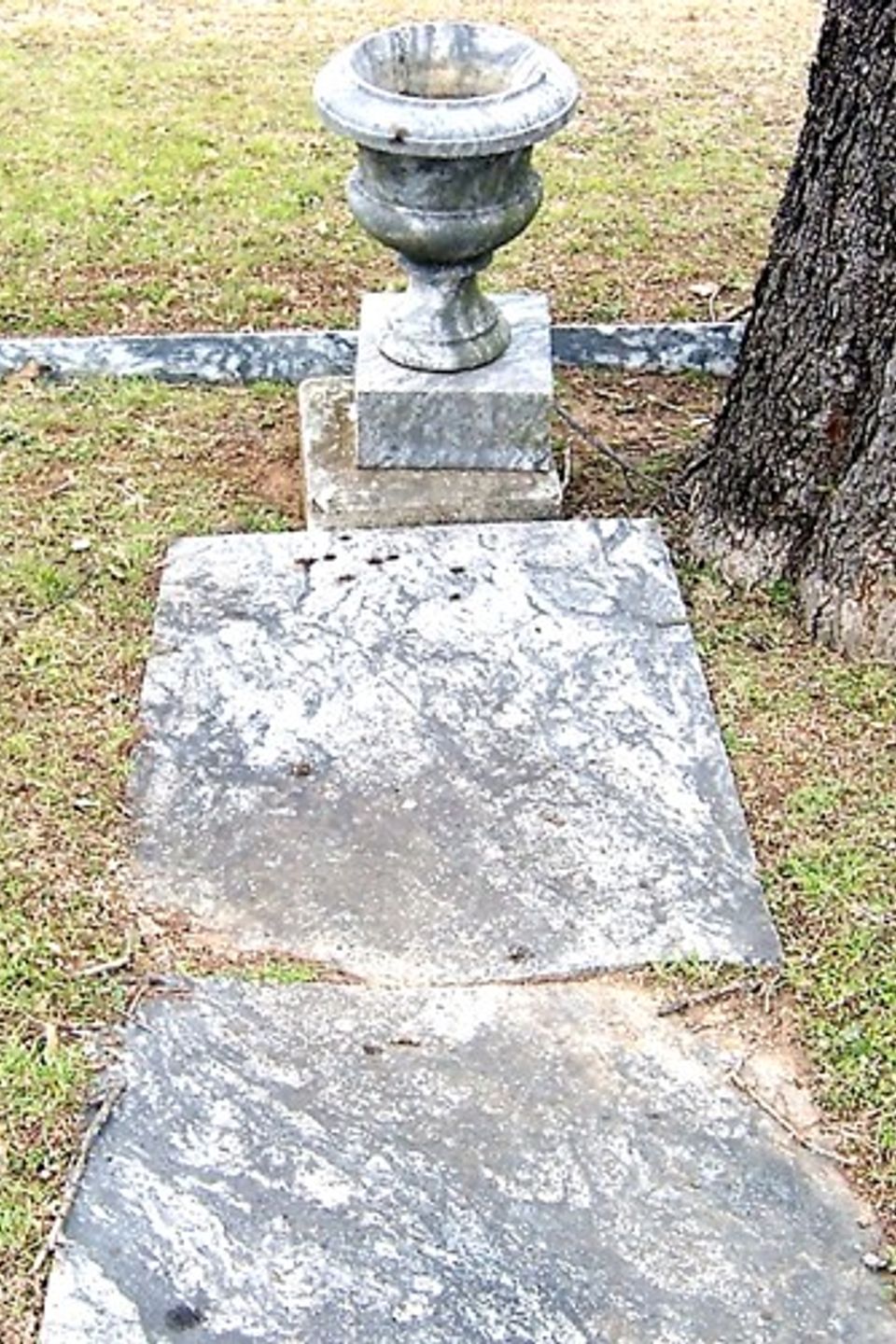
Headstone   james garbutt   broken
Death and Legacy

James Garbutt died January 25, 1894, in Tarrant County, Texas. Based on his reported birth year of 1821, he was approximately 72 or 73 years old. His exact birth date has not been established, so the precise age at death remains uncertain. He was laid to rest in Oakwood Cemetery in Fort Worth (Block 19, Lot 6, Space 5). Over time, his headstone was toppled over and broken.

Garbutt's widow, Sophia, survived him. The 1902–1903 Fort Worth city directory lists her as living on East Lake Avenue between Grand and 12th Streets in North Fort Worth.

Over two years later, on May 5, 1906, she finally applied for a widow's pension based on her late husband’s Civil War service. Her reason for delaying the filing, and the absence of a pension certificate number on the associated pension file index card, leaves uncertainty as to the outcome of her claim. At any rate, she continued to be identified with Fort Worth more than a decade after her husband's death.

James Garbutt's life was one of considerable movement and change. Born in England, he became an American citizen by residence and service, entered the Union Army at approximately 40 years of age, and spent his postwar years pursuing business opportunities in Illinois and Texas. His career included hotels, a wagon yard, farming, and property interests. Along the way, he experienced both favorable business recognition and apparent financial and legal difficulties.

His military service with the 5th Ohio Cavalry remained an important part of his identity long after the war. His pension application, census veterans schedule, burial in Fort Worth, and membership in Parmley Post No. 4 all help preserve the story of a Union veteran who ultimately made North Texas his home.

Although the surviving records leave many details of his early life and family history unanswered, they provide a meaningful outline of his journey from England to Ohio, Illinois, and finally Texas. His inclusion in the Department of Texas, G.A.R. death roll ensures that James Garbutt is remembered not only as a businessman and Fort Worth resident, but also as one of the Union veterans who helped sustain the memory and fellowship of the Grand Army of the Republic in Texas.

 
REST IN PEACE, COMRADE GARBUTT!


Visit Our Social Media...and Feel Free to Share With Others!