Early Life in Alabama
Charles C. Cock was born August 20, 1844, in Fayette County, Alabama, the son of Charles and Mahala Cock. Although little is known about his early childhood, federal census records provide a few glimpses into the family and the circumstances in which he grew up.
The 1850 federal census, taken October 29 in Fayette County, found 6-year-old Charles living with his parents and seven siblings. His father worked as a blacksmith, a skilled occupation that would have provided a livelihood for the large family. Both parents were reported to be 42 years old and natives of Tennessee. The family surname appeared as "Cox" in this census, one of several spelling variations that would follow Charles throughout his life.
By 1860, the family had moved to neighboring Marion County in northwestern Alabama. The census, taken June 24, recorded the household under the surname "Cocks." Charles's father, now 51, was employed as a mechanic and had accumulated $2,000 in real estate and another $300 in personal property. The household included Martha A. (30), Diana (24), Matilda (19), Charles C. (15), Jeremiah D. (12), and 9-month-old Susan S. ‘Cocks’.
The 1860 census raises an interesting question about the family's composition. Charles's mother, Mahala, was no longer listed, suggesting that she had died sometime during the preceding decade. Martha, the oldest female in the household, was considerably older than the other children and had not appeared in the 1850 household. She may have been an older sister who had previously established a separate residence and subsequently returned in 1860. Although her relationship to the elder Charles is not entirely certain, the 21-year age difference between them makes it more likely that she was his daughter rather than a second wife.
For young Charles, the decade between the censuses had brought the transition from childhood toward adulthood. At 15, he was already working as a farm laborer, helping support the household. His ordinary teenage years, however, were soon overtaken by extraordinary events. The Civil War began the next year, and Charles made a decision that placed him among a relatively small group of Alabama residents – he chose to fight for the Union!
Civil War Service in the Union Army
Charles C. Cock's military service is particularly noteworthy because he became a Union soldier from Alabama, a state that had seceded from the Union in January 1861. Although Alabama was firmly within the Confederacy, approximately 2,500 White Alabamians served in the Union Army. Charles was among them.
According to the military account included in his online Find A Grave memorial, Charles enlisted in November 1862 and was mustered into service as a Private in Company E, 1st Regiment, Middle Tennessee Cavalry. The regiment was subsequently redesignated as Company K, 1st Regiment, Alabama Cavalry (New), a federal unit organized at Huntsville, Alabama, and Memphis, Tennessee.
There is, however, a discrepancy concerning his enlistment date. His VA Master Index Card (Form 7202) and the Special Veterans Schedule of the 1890 federal census both give July 24, 1862, as his enlistment date. This earlier date appears more reliable. The Veterans Schedule also credits him with 2 years, 10 months, and 18 days of military service, a period consistent with an enlistment in July 1862 and his eventual discharge in June 1865.
Whatever the precise date of his initial enlistment, Charles's wartime experience proved unusually eventful. His military record documents repeated captures, periods of missing-in-action status, imprisonment, and the hardships associated with campaigning across several states.
One of his encounters with Confederate forces occurred during the Battle of Day's Gap in northern Alabama. On April 30, 1863, while the Union cavalry operated in the rugged terrain of the region, Charles was captured by Confederate troops. Fortunately, his captivity was relatively short. He was paroled and returned to his regiment at Huntsville on July 24, 1863. He was then 18 years old and continued serving as a Private in Company K, 1st Alabama Cavalry.
His troubles were far from over. On October 26, 1863, during the Battle of Vincent's Cross Roads in northeastern Mississippi, Charles was again reported missing in action. This time, he remained away from his regiment for nearly 3 months. He eventually made his way back and rejoined his comrades on January 14, 1864.
The final months of the war brought another period of captivity. On March 10, 1865, while his regiment was participating in the Campaign of the Carolinas, Charles was captured at Solemn Grove, near Fayetteville, North Carolina. He was subsequently transported to Richmond, Virginia, the Confederate capital, arriving on March 21. There he was confined in one of the city's notorious prisoner-of-war camps.
Once again, his imprisonment was brief. By March 31, Charles had reached Camp Parole in Maryland, where exchanged and released Union prisoners were processed and temporarily accommodated. He was granted a 30-day furlough beginning April 9 and returned to his regiment on May 3, 1865.
With the Confederacy collapsing and the war nearing its conclusion, Charles's military career was finally coming to an end. He was mustered out of service at Camp Chase, Ohio, on June 12, 1865. He was just 20 years old. In less than 3 years of military service, he had experienced multiple captures, imprisonment, lengthy absences from his regiment, and the uncertainties of campaigning far from home. His survival and eventual return to civilian life marked the conclusion of a remarkable chapter in the life of this young Alabama Union soldier.
Marriage, Family, and a New Beginning
Following his discharge, Charles returned to Alabama and began rebuilding his life. On December 10, 1865, according to the online Peart Family Tree (Ancestry.com), he married Mary Pundy Adkins-Halcomb, a widow and native of Alabama.
Mary had previously married Wiseman Halcomb in Marion County, Alabama on July 14, 1861. Their son, John Thomas Halcomb, was born March 14, 1862, approximately 9 months after their marriage. Mary's first marriage was tragically short. Wiseman enlisted in the Union Army on July 24, 1862, but died at Huntsville, Alabama, on August 25, just a month later.
An interesting connection between the two men's military experiences appears in the 1890 Special Veterans Schedule. Mary P. Cock was listed immediately following the entry for Charles, identified as the widow of Wiseman Holcomb. The schedule gives Wiseman's service as a Private in Company K, 1st Alabama Cavalry, with an enlistment date of July 24, 1862. His death date is noted as August 20, 1862, after just 27 days of service.
The similarity between the two men's military records is striking. Charles and Wiseman apparently enlisted on the same day in the same company and regiment. It is quite possible that they knew one another, and perhaps even served together before Wiseman's untimely death. Although the surname appears as "Holcomb" rather than Halcomb, the matching military and family details strongly suggest that this was Mary's first husband.
Charles and Mary began their married life together, raising Mary's young son and establishing a farming household. Their first child together, a daughter also named Mary, arrived the following year, and additional children followed.
The 1870 federal census, taken August 3 in Marion County, identified Charles ‘Cocke’, age 25, as a farmer. He owned $250 in real estate and $200 in personal property. Mary, age 29, was keeping house. Their household included John (8), Mary's son from her first marriage, Mary (4), and Barthena C. ‘Cocke’ (1). Also living with the family were 8-year-old Nancy Tucker and James Nagle, a 29-year-old Black laborer.
By 1880, the family had moved westward into Mississippi. The census, taken June 1 in Batesville, Panola County, identified Charles as C. C. Cock, age 35, still working as a farmer. Mary was 40, and their children included M. F. (14), B. A. (11), and N. L. Cock (9). Mary's son from her first marriage, J. T. Halcomb, was now 18 and working as a store clerk.
The 1880 census also included a 3-year-old boy, C. R. Cock, whose entry was crossed through, possibly indicating that the child had recently died. His reported age implies he was born in Alabama around 1877, providing another clue to the family's movements during those years.
Their stay in Mississippi would prove relatively brief. Before long, Charles and Mary would make another move, this time to Texas, where Charles would spend the remainder of his life.
Establishing a New Home in Fort Worth
Charles's arrival in Fort Worth appears to have occurred around 1882. His 1927 obituary reported that he had been a resident of the city for 45 years, placing his arrival at approximately that time. This suggests that the family's residence in Mississippi may have lasted only a few years.
The 1890 Special Veterans Schedule for Tarrant County, Texas provides further evidence that Charles had established himself in Fort Worth by that time. It documents his Union service in Company K, 1st Alabama Cavalry, serving from July 24, 1862, through June 12, 1865.
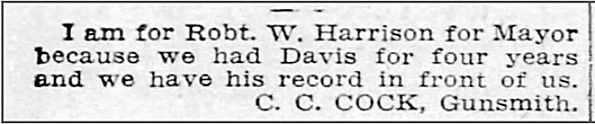
His move to Fort Worth also marked an important change in his working life. After years as a farmer in Alabama and Mississippi, Charles developed a skilled trade as a gunsmith and locksmith. The growing Texas city offered opportunities for someone with mechanical abilities, and his business appears to have become a familiar part of the local community.
An interesting newspaper reference appeared in the May 20, 1893, edition of the Fort Worth Daily Gazette. Under a brief notice concerning local business activity, the newspaper reported:
"Charles C. Cock, gun and locksmith – Business, if anything, is better."
Although only a single sentence, the notice provides a welcome glimpse into Charles's professional life. It suggests that his business was sufficiently established to attract attention in the local press and that he was enjoying favorable trade. His occupation would continue to appear in subsequent census records.
Comrade in the Grand Army of the Republic
Charles also maintained an important connection with fellow Union veterans through membership in the Grand Army of the Republic (G.A.R.), the fraternal and patriotic organization established in 1866 for Union Army and Navy veterans. The G.A.R. provided former soldiers with opportunities to commemorate their military service, assist fellow veterans, and participate in patriotic and charitable activities. Its local organizations, known as Posts, became important centers of Union veteran activity throughout the country.
In Texas, the organization had experienced an earlier period of activity during Reconstruction, but the Department of Texas was not permanently organized until 1885. Local Posts were then established in communities throughout the Lone Star state. Charles became affiliated with Captain William S. Parmley Post No. 4 in Fort Worth, one of the earliest Posts organized in the Department of Texas.
His participation is documented as early as 1892. That year, C. C. "Cocks" of Parmley Post No. 4 was elected by his comrades as an Alternate Delegate to the 7th Annual Encampment of the Department of Texas, held in El Paso. Although elected to represent his Post, Charles was unable to attend. His election nevertheless demonstrates that he had become a recognized member of the Fort Worth veteran community.
Family and Business in the New Century
The 1900 federal census provides another useful picture of Charles' life in Fort Worth. On June 11, he was living at 112 Live Oak Street with his wife, Mary P., and their daughter, Mary F. Identified as Charles C. ‘Cox,’ he was 55 years old, born in Alabama in August 1844, and employed as a gunsmith. He owned his home free and clear and was reported to be literate. Mary was 60 and gave her birthdate as February 1840. The couple reported having been married for 34 years. Their daughter Mary F. ‘Cox’, age 33, was unmarried and unemployed.
One detail in the 1900 census is difficult to reconcile with earlier records. Mary reported having given birth to only one child - and that child was still living - despite the several children previously recorded in the family's household. This appears to be an error in the census information, particularly given the other documentation of their children.
Charles's business continued to serve as a local point of contact for commercial activity. An advertisement published in the Fort Worth Record and Register on July 25, 1901, offered a first-class boot and shoe shop, including its tools and stock, for sale at a reduced price. Interested buyers were directed to apply at C. C. Cock's establishment at 105 West First Street. The advertisement offers another small but interesting glimpse into the role his business played in the commercial life of Fort Worth.
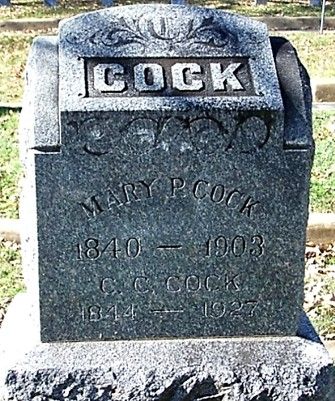
Mary's death in 1903 brought an end to their nearly 38 years of marriage. Her grave monument gives her lifespan as 1840–1903, indicating she passed away in her 62nd or 63rd year.
By 1910, Charles was living at 1414 East Belknap Street with John D. and Mollie Hutchinson, identified in the census as his son-in-law and daughter. The couple had been married only a year and had no children. Charles, now 66, was still working as a gun and locksmith on his own account. He was noted as having been married only one time, but, of course, had been a widower for approximately 7 years. His continued employment suggests that he remained productive and financially independent well into his later years.
The 1910 membership roster of the Department of Texas, G.A.R., compiled by Department Commander C. R. Hubbard, confirms his continued membership in Parmley Post No. 4. The listing identifies him as C. C. Cock, formerly a Private in Company K, 1st Alabama Cavalry, then residing in Fort Worth.
Continued Service to Parmley Post No. 4
Charles's interest in the G.A.R. extended beyond simply maintaining his membership. He continued participating in Post activities and remained connected with the larger fraternity of Union veterans. In August 1913, the Fort Worth Record-Telegram published an article titled "Local Grand Army Men Arrange for the Chattanooga Reunion." It described a recent meeting of Parmley Post members at the courthouse, where arrangements were being made to attend the 1913 National Encampment of the G.A.R. in Chattanooga, Tennessee, scheduled for September 15.
A special Pullman car was being arranged for the Texas veterans, with departure from Dallas planned for September 13. Among those who announced their intention to attend was C. C. Cock. His proposed participation in this national gathering demonstrates that he remained interested in the organization nearly half a century after his own military service.
In December 1915, the Fort Worth Star-Telegram reported that C. C. "Cox" had been elected as Inside Guard of Parmley Post No. 4. His formal installation was scheduled for January 3, 1916, at the Odd Fellows Hall, located at First and Throckmorton Streets. As Inside Guard, Charles would have been responsible for security and proper conduct of Post meetings, an important responsibility within the organization's established system of officers. His election reflects the confidence his comrades placed in him.