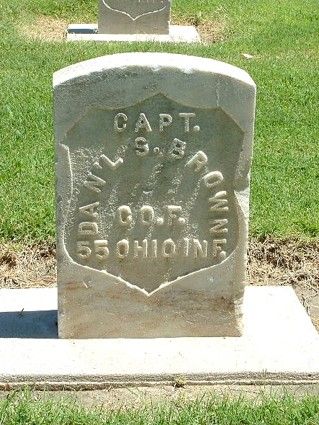
From Ohio to the Union Army
Brown was born in Ohio in October 1830. His parents were identified in his 1896 marriage record as David and Sarah Brown, both natives of Pennsylvania. Little is known about his early childhood, but by the spring of 1861, he was 30 years old when the Civil War erupted. As a very early volunteer, Brown enlisted with the Union Army on April 23, 1861. He served in Company C of the 15th Ohio Infantry, entering the regiment as a 1st Sergeant. He mustered into service four days later, on April 27. His initial military service lasted only a few months. On August 28, 1861, he was discharged from the regiment so that he could accept a commission as a 1st Lieutenant in Company F of the 55th Ohio Infantry. Brown began his service with the 55th Ohio about two weeks later, on September 15, 1861.
He served as a 1st Lieutenant for a very short time before being promoted once again – this time to Captain, on October 16. This rapid advancement placed him in a position of responsibility for the men under his command and established the rank by which he would later be remembered. His military career thus progressed from enlisted leadership in one Ohio regiment to commissioned service in another.
Unfortunately, the Civil War exacted a heavy physical toll on Brown. His military record notes that he was severely wounded on August 30, 1862, during the Second Battle of Bull Run in Virginia. The engagement, also known as Second Manassas, was a major Confederate victory that forced Union forces into retreat and contributed to the crisis preceding Confederate General Robert E. Lee's first invasion of the North. For Brown, the battle would have consequences far beyond the fighting itself.
Later newspaper accounts described him as having been shot either through both legs or through the hips. Although the descriptions differ, they agree that his injuries were severe. Brown became dependent on canes to support himself when standing, and his disability remained a defining feature of his later life.
On February 16, 1863, Brown was honorably discharged from the 55th Ohio Infantry because of his debilitating wounds. His military career therefore ended well before the Civil War concluded in 1865, not because he voluntarily resigned, but because his injuries prevented him from continuing in service.
On April 3, 1863, he applied for an invalid pension based on his military service and resulting debility. His pension file records confirms his service as a Captain in Company F of the 55th Ohio Infantry, and also notes his earlier service in Company C of the 15th Ohio Infantry. The details included on his pension application provides an important connection between his wartime injuries and the physical hardships that followed.
Although Brown's active military service was relatively brief, his identity as a Union veteran remained central to his later activities, particularly his involvement with organizations dedicated to preserving the memory and fellowship of those who had served.
Building a Life in Texas
Following his military service, Brown eventually made his way to Fort Worth, Texas. The precise date of his arrival is not established, but a newspaper account published in August 1890 described him as an Ohio native who had lived in Texas for 18 years, suggesting that he arrived around 1872.
Texas offered Brown a new setting in which to build his life. In 1872, the state was still experiencing the political and social turmoil of Reconstruction, while its growing railroad network and expanding agricultural economy attracted settlers from around the country. Brown became involved in two important areas of public life: the Republican Party and the Grand Army of the Republic.
Not long after his arrival in Texas, he married Sarah. They became the parents of a son, Paul R. J. Brown, about 1877. The youngster was three years old when the 1880 census enumerator visited the Brown household in June. They lived on Throckmorton Street in Fort Worth. Brown was 50 years old and reportedly employed as a carpenter. His wife, Sarah, was much younger at age 27. His unmarried 21-year-old sister-in-law, Rosa Caldwell, was lodging with the family.
The G.A.R. had been established nationally in 1866, but its permanent establishment in Texas came in 1885. The organization brought together Union veterans who wished to preserve their wartime fellowship, honor the service and sacrifices of Union soldiers and sailors, and maintain the memory of the cause for which they had fought. For veterans living far from their former comrades, the local Texas Posts provided a means of sustaining those connections and continuing their commitment to patriotic service.
Brown's personal circumstances were not without hiccups. On May 14, 1887, the Fort Worth Daily Gazette reported on the divorce suit brought against him by his wife, Sarah. The court had dissolved their marriage, awarded custody of their child to her, and granted her the real estate they owned in Fort Worth valued at $8,000. Despite such personal setbacks, Brown persevered and developed a prominent role among the Union veterans living in Texas.
Leadership in the Grand Army of the Republic
Brown became an early active member of Capt. William S. Parmley Post No. 4, G.A.R. of Fort Worth. In 1888, he served as one of the Post’s first Commanders. In December that year, he authored a newspaper notice announcing the names of the Post officers elected at their regular business meeting who would serve during the next year. In addition, Brown served as the installing officer for those officers-elect on January 15, 1889. This role followed naturally from his status as a Past Post Commander. The occasion demonstrated that he remained committed to the Post's administration even after his own term of leadership had ended.
Brown's G.A.R. responsibilities soon extended beyond Fort Worth. In January 1889, he was elected Senior Vice-Commander of the Department of Texas for the 1889–1890 term. General Order No. 1, issued by the Department Commander, dated February 26, 1889, announced his election. This new position placed him among the Department's senior leaders and gave him a role in the administration of the organization across the state.
At the Department's 5th Annual Encampment, held in San Antonio in March 1890, Brown attended as a Past Post Commander and Department Senior Vice-Commander. During the elections for 1891 Department Officers, he was one of five nominees for the office of Department Commander. However, his name was strategically withdrawn after the first ballot, on which he received only 5 of the 66 votes cast.
Although Brown did not secure the Department's highest office, his nomination demonstrated that his fellow veterans considered him a leadership candidate. His service also reached the National level of the G.A.R. The Journal of the 24th National Encampment of the Grand Army of the Republic, held in Boston in August, 1890, listed Brown as an Assistant Inspector-General. His appointment had been announced earlier in General Order No. 6, dated November 29, 1889.
Brown’s record thus reflects a progression from local Post Commander to Department Officer to national appointee. Even after he ceased attending annual Department Encampments, his earlier service continued to be recognized in the organization's subsequent proceedings reports. He was listed as a Past Post Commander in the records of the 1892 Encampment in El Paso and the 1893 Encampment in Denison, although he attended neither meeting.
A Republican and Advocate for Texas Immigration
Brown's activities were not limited to veterans' affairs. He also became a prominent figure in Tarrant County politics. A detailed article published in the Fort Worth Daily Gazette in August 1890, described him as not only one of the leading members of the G.A.R. in Texas, but also a political leader who had served as Chairman of the county Republican Executive Committee before the recent county convention.
A GRAND ARMY MAN
One of the Leading Members of that Body in
Texas Relates Some Incidents of HisTrip to the North
(Fort Worth Daily Gazette, Fri., Aug 29, 1890, pg. 1)
The newspaper article, titled “A Grand Army Man,” recounted Brown's recent return from the North after attending the national G.A.R. Encampment in Boston with other members of the Department of Texas. His journey had not gone entirely according to plan. An illness forced him to interrupt his travels and remain in Pennsylvania for approximately two weeks.
Rather than allowing the unexpected delay to go to waste, Brown used the opportunity to promote his adopted state. He spoke with Pennsylvania farmers about Texas, its climate, its agricultural potential, and the comparatively low cost of its land. The Gazette reported that he found the farmers eager to learn about the state and surprised by his descriptions of its opportunities.
Brown recognized that many Pennsylvania families were quite prosperous, owned their farms, and had accumulated money that could be invested in new agricultural ventures. With a new generation approaching adulthood, he reasoned, the parents would be looking for places where their sons could establish farms and build independent lives.
He was particularly encouraged by the interest he encountered among Pennsylvania Dutch farming communities. According to the newspaper, some of the people he met struggled to understand how a former Union soldier, and a Republican to boot, could have lived in Texas for 18 years!
The Pennsylvanians also apparently believed that Republicans in the Lone Star state were unable to organize freely. Brown challenged those assumptions. He explained that Republicans could hold conventions and that Texas was not the place his northern listeners imagined it had been two decades earlier. His comments reflected both his political convictions and his desire to counter negative perceptions of his adopted home.
He also offered practical advice to those seeking to attract settlers to Texas. In his view, immigration agents needed to venture beyond the large cities and visit rural communities to speak directly with farmers. He praised the Fort Worth Daily Gazette as an effective means of publicizing Texas, observing that some of the northern people he met had never imagined the state could produce such a newspaper.
Brown believed that the area around Altoona, Pennsylvania, offered particularly promising prospects. He estimated that approximately 1,000 immigrants might be attracted from that region alone, and suggested that individual families could bring between $5,000 and $150,000 with them to purchase and improve Texas farmland.
Of course, these figures were Brown’s personal estimates, rather than verified immigration numbers. Nevertheless, the account reveals Brown as a practical-minded advocate who understood the importance of personal contact, favorable publicity, and economic opportunity. His unexpected stay in Pennsylvania had become an opportunity to promote the state where he had chosen to make his home.
Improving Pension Access for Union Veterans
Brown's concern for fellow veterans was also evident by his efforts to improve access to federal pension medical examinations. Before 1891, Union veterans in Texas had to travel to San Antonio or Dallas to be examined by a board of federal surgeons. For disabled and aging veterans, such journeys could be burdensome. Brown and others represented these difficulties to the federal government, arguing that Fort Worth's importance as a railroad center made it a suitable location for such examinations. Their request received a favorable response.
A report in the Fort Worth Daily Gazette on July 9, 1891, announced that the government had finally established a pension examination center in Fort Worth. Three examining surgeons were appointed by the Pension Bureau, with Wednesdays each week designated as examination days. The newspaper reported that between 15 and 25 men were coming to Fort Worth each week to undergo medical examinations, often spending a day or two in the city.
Brown's own invalid pension application and persistent disability make his interest in the matter particularly noteworthy. His efforts helped turn Fort Worth's railroad connections into a welcome service for other fellow veterans.
Brown continued to be involved in the affairs of the Department of Texas during this period. During the 6th Annual Encampment in Dallas in March 1891, he was one of three men appointed to escort the delegation from the Woman's Relief Corps, the allied organization of women associated with the G.A.R. This appointment reflected the ceremonial responsibilities that accompanied his standing within the Order. In addition, he continued to be listed among the Department's past Post Commanders in subsequent years, recognizing the lasting significance of his earlier leadership roles.
Marriage, Work, and Changing Circumstances
Brown's personal life continued to evolve during the 1890s. On December 28, 1896, he and Emma Bredig obtained a marriage license in Tecumseh, Pottawatomie County, Oklahoma Territory. He was 66 years old, born in Ohio, and residing in Pottawatomie County. Emma was recorded as 40 years old and born in Arkansas. A newspaper account published in The Tecumseh Leader on January 8, 1897, reported that the couple had married two days later, on December 30, 1896, at the home of Emma's sister, Mrs. Weaver, three miles south of Dale, Oklahoma. The ceremony was performed by Rev. L. B. Parker. The newspaper described Emma as an accomplished and talented young woman and Brown as a substantial and respected farmer in Pottawatomie County.
By 1889, Brown had apparently returned to Fort Worth. The circumstances of his return to the Lone Star state are not known. The Fort Worth City Directory for that year shows that Brown was commissioned as a Notary Public, with his office located at 4 Victoria Building in Fort Worth.
The June 6, 1900, the federal census indicates Brown was living at 814 Main Street. It listed him at 69 years old, a widower, and a claim agent. He was literate, rented his home, and had been employed throughout the preceding year. The designation of widower indicates that his marriage to Emma had ended before the 1900 census was taken. Brown's occupation as a claim agent is consistent with his interest in pension claims-related matters.
California and a Final Marriage
In 1903, Brown entered another chapter of his life. On March 18, he married Mary R. Armstrong in Long Beach, Los Angeles County, California. Their marriage record shows his age as 72 and identifies him as a native of Ohio. Mary was 44 years old and had been born in Canada.
The April 1910 federal census identifies Brown’s marriage to Mary as his third, which is consistent with the records of his earlier marriages to Sarah B. Brown and Emma Bredig. Mary would remain his wife until his death in 1911. The census enumerator found Brown and his wife living on Juanita Street in Hemet, Riverside County, California. At 79 years of age, he was living on his ‘own income’ and owned his home free and clear of a mortgage. The census also identified him as a survivor of the Union Army.
Mary, listed as 51 years old, had immigrated from Canada in 1902. She was literate, and had no occupation outside the home. The enumerator noted that the couple had been married for seven years, placing their marriage in agreement with the 1903 marriage record.
It seems that by 1910, Brown's circumstances had changed considerably since the 1900 census. He went from renting a house in Fort Worth in 1900, to owning his California home outright. He apparently had achieved a measure of residential stability during his final years.
However, his physical condition remained a serious concern. The wounds he sustained during the Civil War had left him with limited mobility, and he relied on canes to support himself when standing. The consequences of his wartime service would ultimately contribute to the tragedy of his final months.
A Fatal Accident and the End of His Life
In March 1911, Brown suffered a serious fall at his home in Hemet, California. According to a Los Angeles Times news item, he had attempted to pull himself upright by grasping a revolving chair. The chair unexpectedly turned, throwing him to the floor and breaking the bone in his leg in two places near his hip.
The newspaper described him as a ‘crippled invalid’ whose earlier war injuries complicated his treatment. Physicians reportedly found it impossible to set the fractures because of his condition. At more than 80 years of age, Brown faced a difficult recovery, and the newspaper expressed little hope that he would survive.
The fall did, in fact, eventually prove to be fatal. Brown died at his home on North Juanita Street at noon on May 24, 1911, only about two months after the accident. “The patient old hero fought death bravely, but his advanced age and poor health were against him and the shock was too great.” His death was reported in both the Los Angeles Times and the Riverside Daily Press on May 27.
Brown’s obituaries remembered him as a veteran who had served with distinction in some of the bloodiest battles of the Civil War in Tennessee and Virginia. They praised his bravery and described his rise from Private to Captain. Their accounts, however, differ from the official service record concerning the rank in which he enlisted and the length of his military service.
One particularly poignant detail concerned Brown's brother, A. N. Brown. According to the obituary, A. N. had traveled from Texas to Long Beach for a visit approximately a month before Brown’s death. The brothers had not seen one another for 30 years. Given the timing, it is likely that A. N. traveled to California after learning of his brother's serious accident, rather than the reunion being a coincidence. At any rate, the visit brought the brothers together again, although briefly, after three decades apart.